
WHY DATA VALIDATION AND RECONCILIATION (DVR) SUPPLEMENTS PROCESS SIMULATION
PROBLEM DEFINITION
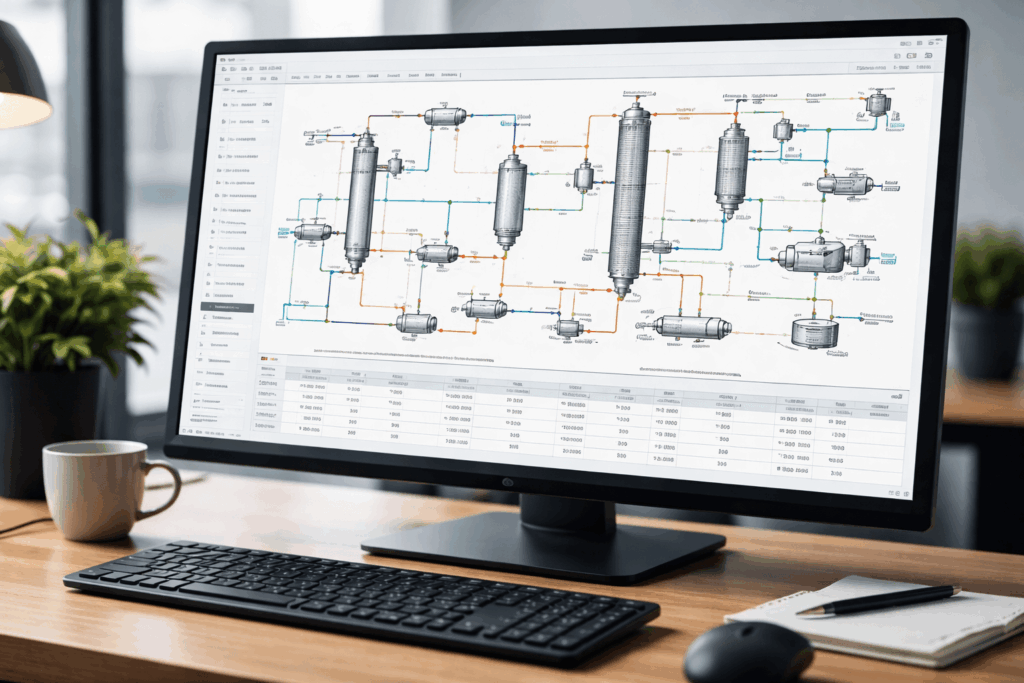
Classic process simulators are widely used for system design, and their applications increasingly extend to online monitoring and optimization. These models rely on live field measurements collected from instruments such as flowmeters, pressure sensors, and temperature sensors.
However, most conventional simulators do not explicitly account for the statistical nature of measurement data, including uncertainty and potential bias. As a result, if raw measurements are faulty, inconsistent, or drifted, the simulation outputs may become inaccurate and potentially misleading.
CHALLENGE
In conventional process simulators, a variable can either be fixed to a measured value or calculated by the model. However, measurements of variables that are already determined by model equations cannot simply be imposed as additional inputs without modifying the model structure. Doing so leads to over-specification, where the system becomes overdetermined due to excessive constraints. In such cases, the simulator raises an error because the mathematical problem no longer has a consistent solution.
SOLUTION
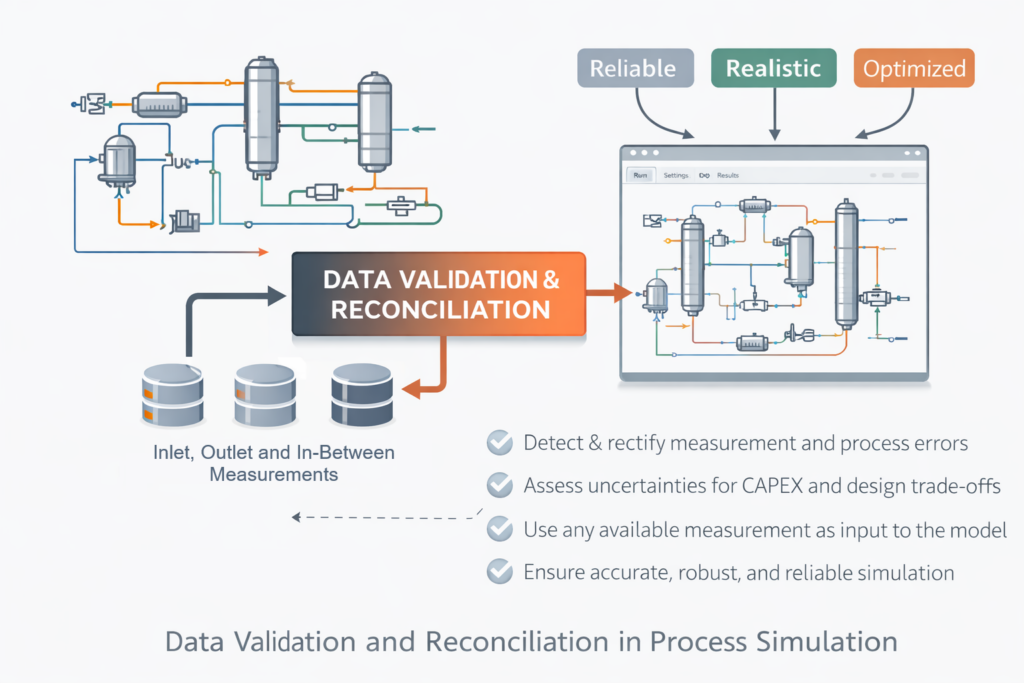
A comprehensive Data Validation and Reconciliation (DVR) modeling methodology is proposed to systematically detect and correct measurement and process inconsistencies as an integral part of reliable simulation practice. By validating and reconciling plant data before it is used in models, this approach ensures that high-quality, consistent data is available for process simulations, operational monitoring, and process surveillance. In addition, the methodology can be used to evaluate the impact of uncertainty in both measured and unmeasured variables, supporting more informed capital expenditure decisions and enabling optimized instrument and meter design.
BDI provides a process simulation solution based on DVR methodology combined with an advanced statistical framework. Unlike traditional simulators, which typically rely on inlet measurements to estimate all other measured or unmeasured variables, the DVR approach allows any available measurement, whether at the inlet, outlet, or within the process, to be used as model input together with its associated uncertainty. By leveraging measurement redundancy and physical process constraints, this approach delivers more accurate, robust, and reliable simulation results.
PROCESS MODELING & RECONCILIATION
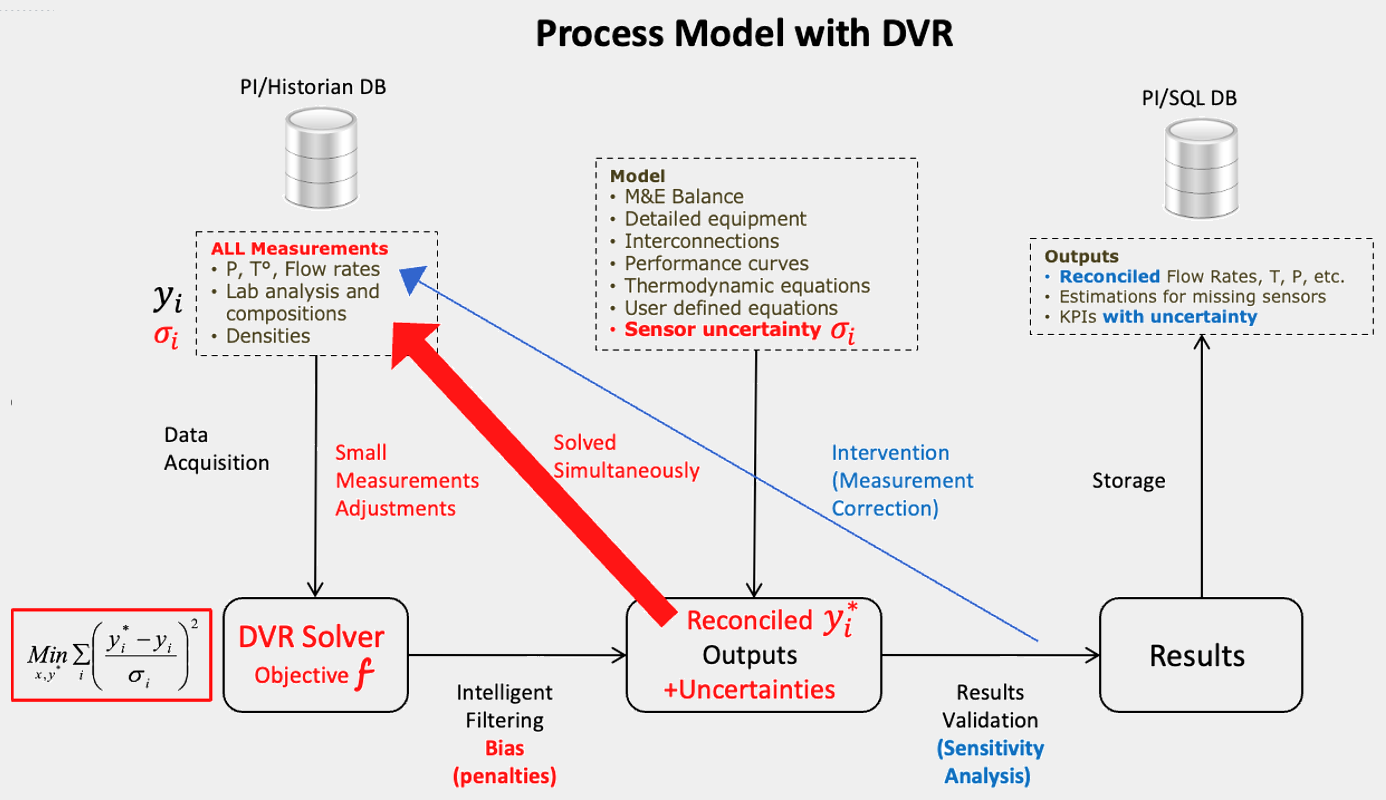
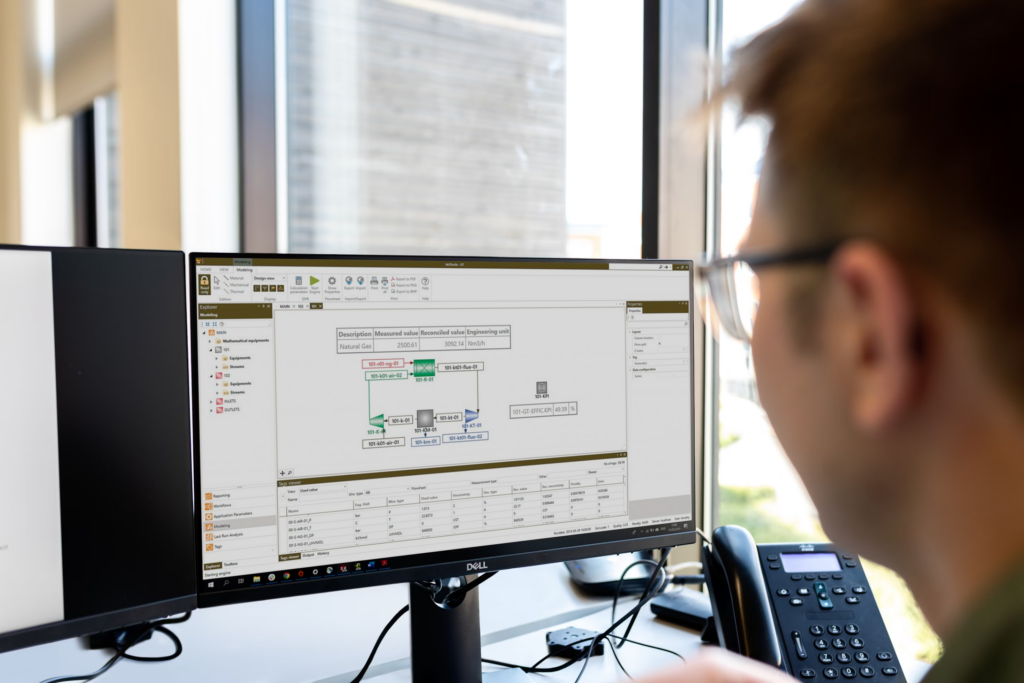
A fast iterative inner loop is embedded within the model calculations, as illustrated by the red arrows and highlighted components. This loop represents the statistical layer of the DVR methodology and its iterative reconciliation process, which generates reconciled measurements, often referred to as twin values (Y*i).
Unlike conventional process simulation, the DVR methodology allows all measurements (Yi) to vary within their defined uncertainty ranges. The algorithm iteratively adjusts these values until it identifies the optimal set of reconciled measurements that minimizes the objective function. Once convergence is achieved, DVR returns the reconciled values (Y*i) along with their associated uncertainties. During this process, the entire steady-state system is solved simultaneously while strictly respecting the physical laws governing the process. Advanced non-linear numerical solvers are used to ensure convergence when dealing with complex non-linear relationships, such as thermodynamic equilibria.
During the diagnostic iterations, measurements that are inconsistent with the process model are identified through penalty indicators. These penalties highlight potential biases or faulty measurements, prompting the user to investigate, recalibrate instruments, or review fluid samples responsible for the discrepancy.
KEY DIFFERENTIATING BENEFITS
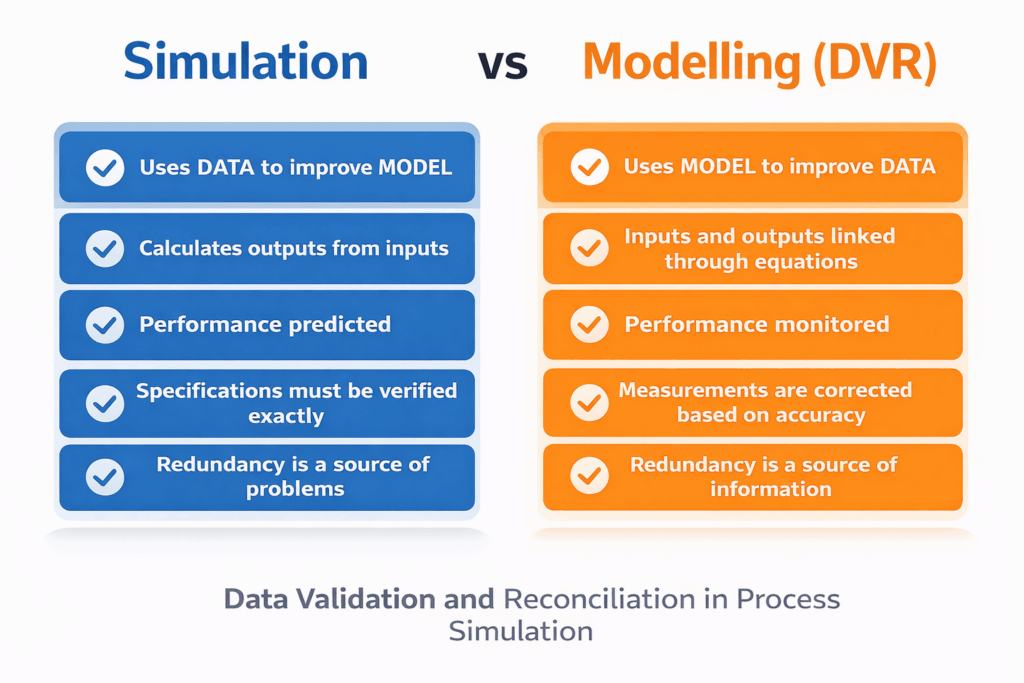
Several key benefits differentiate the DVR solution from conventional process simulation approaches:
Reliable data foundation: DVR ensures that only validated and reconciled data are used in process simulation models by first cleansing and validating measurements.
Physically consistent modeling: All measured and calculated variables are linked through multidirectional physical constraints and functional relationships.
Continuous performance monitoring: DVR enables ongoing monitoring of process performance, supporting early detection of deviations and opportunities for improvement.
Statistical treatment of measurements: Measurement uncertainties are explicitly considered, allowing values to be adjusted within their statistical confidence ranges.
Value from data redundancy: Redundant measurements are used as additional information to reduce uncertainty and improve the reliability of simulation results
SUPPORT
The technical and service support provided by BDI is a key factor in the success of every project. The company relies on a dedicated team of experienced software developers and process engineers who possess extensive expertise in deploying advanced modeling and data reconciliation technologies in industrial environments.
From the early stages of model conceptualization and design, BDI works closely with clients to understand their processes, instrumentation, and operational objectives. This collaborative approach ensures that the developed models accurately reflect the physical system and deliver meaningful insights.
Support continues through project implementation, integration with plant data systems, and commissioning. Belsim also provides comprehensive training and ongoing technical assistance to ensure that users can confidently operate and maintain the solution. This end-to-end support ensures that each project is implemented efficiently and delivers lasting value to the client.
AUTOMATION - Workflows
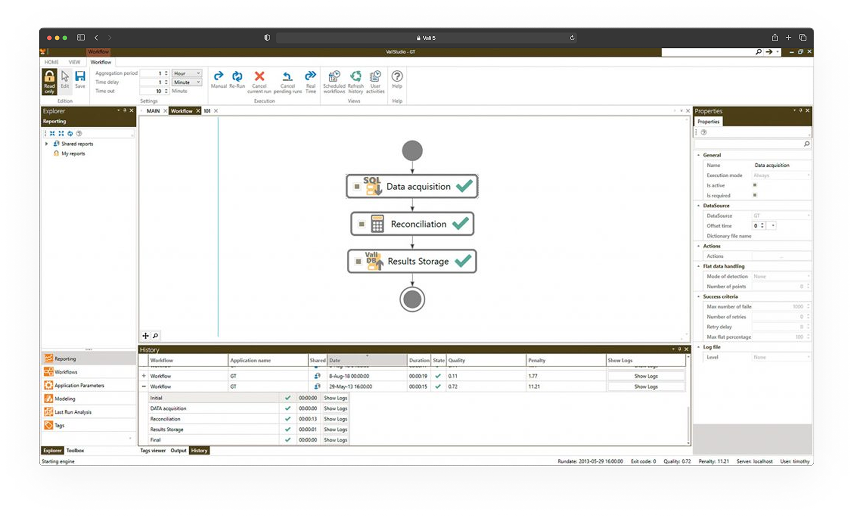
Once the process has been modeled, data reconciliation can be automated through the use of predefined workflows.
These workflows can be configured to run on a regular basis, for example hourly or at any user-defined interval. During each cycle, the system automatically acquires the latest measurements from the data historian, performs the reconciliation calculations, and stores the validated results.
As a result, users continuously receive an updated and more accurate set of process data. Measurements that deviate from the model or from other sensors are clearly identified as potential outliers, enabling faster detection of instrumentation issues, process anomalies, or data inconsistencies.
DATA INPUT AND OUTPUT - REPORTING
Vali’s reconciliation engine receives data from various sources, including the Data Repository layer (such as PI and MS-SQL) as well as from Vali’s own SQL database. This data is then used to generate results that are fed into the Client layer, where reporting and analysis can be conducted using tools like Web and Excel.
Data is captured from the Historian Database at regular intervals, either every few minutes or hours, in order to reconcile and update the measurement values. This process is done in near real-time through automated schedules and customized reports. Any measurements that show inconsistencies with other measurements or the model balances and functional relations are flagged with alerts. The reconciled values are then fed back into the Historian and SQL databases for archiving and future use.